Section01 Introduction to Eigenvalues
Replaces the complicit Matrix with a value ()
- Eigenvectors: Certain expceptional vectors in the same direction as . (When any vectors are the Eigenvectors of ) ()
- Eigenvalues: The value has the same effect to eigenvectors as the matrix . ()
Examples
Question 1: , Calculating
Calculating eigenvalues ()
- How?
- Result of this question
Calculating eigenvectors ()
- The meaning of eigenvectors in the perspective of space
- eigenvectors is contained in the nullspace of
- Solutions of this question (one basis of nullspace)
- The meaning of eigenvectors in the perspective of space
When is squared, the eigenvectors stay the same, the eigenvalues are squred. ( ( is eigenvectors.))
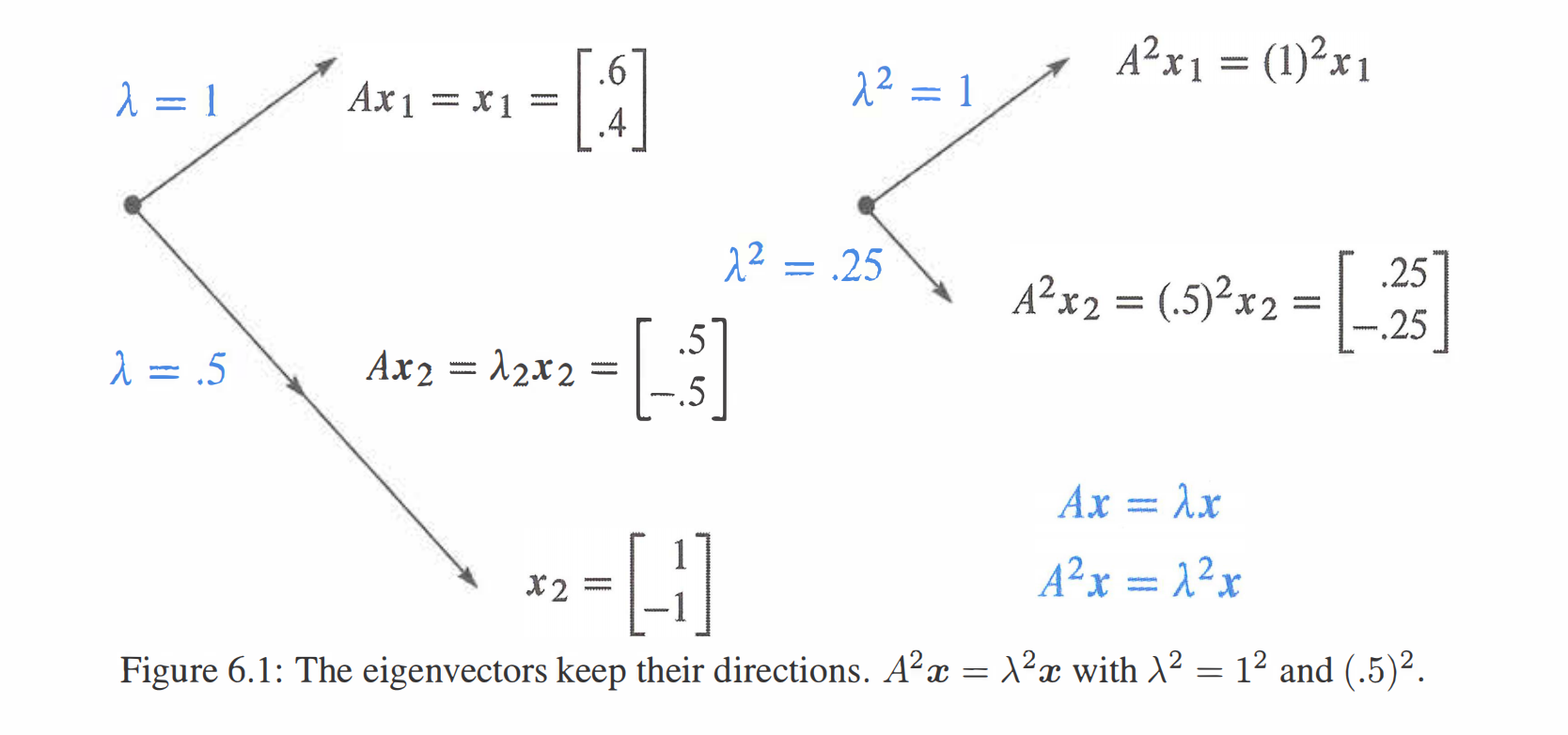
- Separating columns of into eigenvectors
- Why?
- Solutions of this question
Example 2: The projection matrix has eigenvectors and
- Markov Matrix: Each column of adds to 1, so is an eigenvalue.
- Singular Matrix: is singular, so is an eigenvalue.
- Symmetric: is symmetric, so its eigenvectors are perpendicular.
- The properties of projection matrix
- When , , so eigenvector correspond with is the column space of
- When , , so eigenvector correspond with is the nullspace of .
- Any vector could be separated into two eigenvectors. . The projection matrix only persist the part in column space and drop the part in nullspace.
Example 3
- When a matrix is shifted by , each is shifted by . No changes in eigenvectors.
The Euqation for the Eigenvalue
Calculating Steps
- Compute the determinants of . With subtracted along the diagonal, this determinant start with or . It is a polynomial in of degrees .
- Find the roots of this polynomial, by solving . The roots are the eigenvalues of . They make singular.
- For each eigenvalue , solve to find an eigenvector
Determinant and Trace
If you add a row of to another rows, or exchange rows, the eigenvalues usually change!
The product of the eigenvalues equals the determinant.
- Proof
The sum of the eigenvalues equals the summ of the diagonal entries
- Proof
- could be denoted by (The trace of )
Imaginary Eigenvalues
- The eigenvalues might not be real number.
- The eigenvalues of is and . The sum of eigenvalues is ; the product of eigenvalues is .
- The relationship between linear algebra and
- is correspond with real number.
- is correspond with complex number.
Eigenvalues of and
- and share the same independent eigenvectors if and only if
- If vector is the eigenvector of and at the same time, then:
Cayley–Hamilton theorem
- proof
- Properties
- is in the nullspace of ()
Properties from Exercises
Suppose eigenvalues of is , then the eigenvalues of is , the eigenvectors is unchanged.
- proof
Every is in the circle around one or more diagonal entries :
- proof
- Eigenvalues and Eigenvectors of Inverse Matrix ()
- proof
- When there are repeated eigenvalues, the nullspace of has dimension.
- and have the same eigenvalues, but their eigenvectors are transpose to each other.
- Eigenvalues of are .
- When and have the same eigenvalues and eigenvectors, then .
- proof
- Suppose the block has eigenvalues: , block has eigenvalues: , block has eigenvalues: . , eigenvalues of are
- proof
- Suppose permutation matrix , the matrix has the same eigenvalues with . (When do the same column exchange and row exchange, the eigenvalues are unchanged)
- proof
- Suppose two vectors and , , is a eigenvector of
- proof